


Introduction
The great chocolatier Willy Wonka is portrayed as a creator and an inventor. He creates wonders that one can only conceive by pure imagination. But to what end? It’s clear: love for chocolate takes logical priority over inventing. He became an inventor so that he could create chocolate. His act of inventing serves chocolate-making.
God is the creator; He is the fountain of all life and being. To what end? As the story of Scripture unfolds, a divine intent emerges:
God creates, not because He’s needy, but so that He might display His glory in the person and work of Jesus Christ through the power of the Holy Spirit.
Let’s survey Genesis 1 from two angles to understand the narrator’s intent and, therefore, the chief end(s) of creation: 1) A cosmic temple-building project and 2) The stage for the redemptive drama.
Creation: Cosmic Temple-Building
Contextual Clues of a Cosmic Temple in Genesis 1-2
In Genesis 1-2, we see God crafting a “cosmic temple” for His own glory. A temple is a dwelling place for God—a place to house the glory encountered by and ascribed to Him by His creatures. Later, the Bible calls the temple the “house of the LORD” (1 Chronicles 22:2). Though the word “temple” is not present in Genesis 1-2, the concept is.
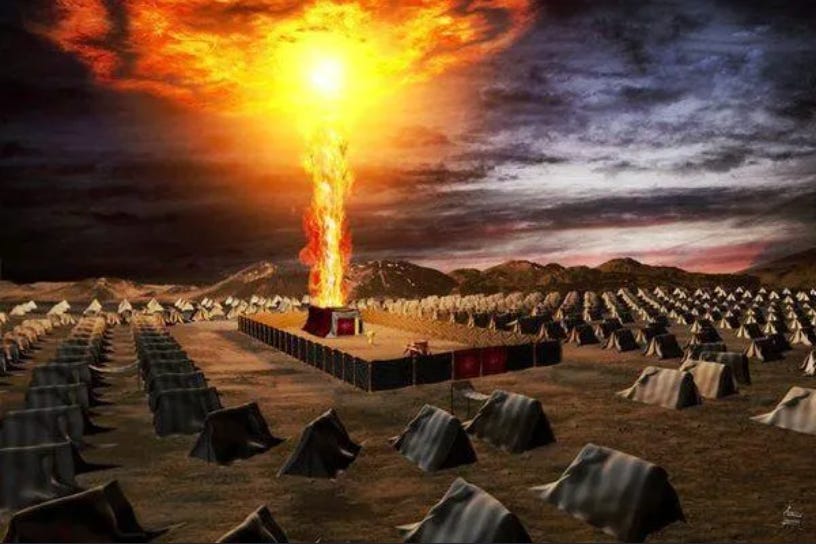
“Temple” may have hovered in a thought bubble above Moses’ head as he wrote Genesis 1 in the wilderness of Sinai, in the presence of a mobile temple called the Tabernacle, or the “Tent of Meeting.” Additionally, he wrote this in a surrounding pagan culture where temples housed pagan gods.
Therefore, to reveal God’s transcendence and secondarily, to write a true account that deflates the pagan creation myths of the day, he writes:
“In the beginning, God created the heavens and the earth…” (Genesis 1:1).
Moses’ God-centeredness is revealed to us in the first verses of the Bible. The ancient audience is to behold God, not necessarily the creatures He forms.
If we start with God, we reason our way down to the cosmos to see a Kingdom and a grand theatre that displays His character. All things are creatures that have their being only through Him and are, by definition, in submission to His rule.
As God speaks, all things come into existence. He desires to dwell with His creation, and He is the centerpiece of it all. Even the Sun is not the source of light at the beginning, but God Himself, revealing that the power of light rests in His very hand, not in a star.1
God is revealed as the self-existent, self-sufficient one who is Father, Son, and Spirit. Why else would He create other than to form others to encounter and enjoy His eternal glory?
God performs His act of creating through a rhythm of lighting, forming, lighting, and filling. This rhythm reveals God progressively moving from outer layers of space to the expanse He calls “heaven,” all the way to the inner layers of the earth itself, crafting a garden that would be the epicenter of His presence. This is revealed in the apex of all of His creation, mankind, as they are set in a Garden-temple:
“So God created man in his own image,
in the image of God he created him;
male and female he created them” (Genesis 1:26–28).
Then on the seventh day, He “rested.” New Testament Scholar, G.K. Beale, points out that this is not a resting in the human sense of the word, but a ceasing that leads to God’s enjoyment and enthronement above all that He has made: “…this resting is unlike our modern conception of rest. God’s resting after six days entails his climactic enthronement as King over the cosmos (Gen 2:2; cf. 2 Chron 6:41; Is 66:1) since ‘it is connected to taking control in his role as sovereign ruler over the cosmos.’”2
This cues us in once again to the idea of a cosmic temple, since as you zoom into the most focused layer of creation—the Garden of Eden—we find God “walking” in the garden in the cool of the day (Genesis 3:8). This speaks of God’s manifest presence.
God primarily dwells in a most holy place called the third heaven, but He dwells (in part) among His creatures, and thus, Eden is the temporal picture of that most holy place. Eden itself is the place from which God’s glory flows.
God and man, man and His maker, creator and creature: No separation, no need for mediation. Not yet. Only perfect communion. Adam and Eve were created to encounter, and encountered, they did.
Beale continues, “Why does God graciously construct a cosmic temple? He desires to rule and reign over the created order, but he also wants to dwell intimately with it.”3
Here, we find God ruling a temple to store the experience of His presence, delegating dominion to man to tend it. This is exactly what a temple would later be made for, the kind of landscape on which it would be located, and exactly what priests would be tasked with doing.
Subsequent Biblical authors concur as they read Genesis 1-2.
How the Rest of the Biblical Authors Read the Creation Narrative
The clarity you’re hoping for about now will come from later revelation.
The idea of creation as a cosmic temple comes about when we apply the principle that later revelation clarifies earlier revelation. Subsequent authors of Scripture write of a dwelling place for God, under the mediation of a priest, something necessary because of the separation between God and man caused by sin.
This dwelling place for God, the Tabernacle, was likely already made when Moses wrote,
“And God said, ‘Let there be lights in the expanse of the heavens to separate the day from the night…” (Genesis 1:14).
This language is used to describe the temple-builders as they construct the lampstands in the holy place. Beale comments:
The word lights in the creation narrative is peculiar, as the same term is applied to the lampstand in Israel’s tabernacle: “the lampstand that is for light with its accessories, lamps and oil for the light” (Ex 35:14; cf. 39:37; Num 4:9). The lights within the cosmos, therefore, function as cultic luminaries that shine throughout God’s cosmic temple, just as the lights on the lampstand illuminate the Holy Place of Israel’s temple…Several scholars have even compared the construction of Israel’s mobile tabernacle to the creation of the cosmos, concluding that God is indeed fashioning a cosmic temple in Genesis 1–2.4
Moreover, from the outer court to the Holy of Holies, each layer of God’s dwelling pointed to some aspect of God’s original creation—the furnishings, the curtains’ colors, the priest’s robes, etc.5 Thus, what can we conclude about the Biblical author’s understanding of creation? Genesis 1-2 was a narrative about a cosmic sanctuary and, most of all, its Builder.
This becomes even clearer when examining Eden itself. As noted above, Eden was the first temple, being the prototype of what the entire globe was to reflect by the work of Adam and his bride.
Adam, therefore, was the first earthly priest, since he was called to “work” and “keep” the garden, the same two Hebrew words used of the priests in Numbers 3:6-10.
Since the Temple of God was considered to be on God’s holy mountain (2 Chronicles 3:1), Ezekiel later calls the Garden of Eden a temple by referring to it as “The garden of God…the holy mount of God” containing “sanctuaries” (Ezek 28:13–14, 16, 18).
Ezekiel also prophesies a future temple with a river of life flowing from the sanctuary, meant to point the reader back to Eden, where the river flowed, giving life to the rest of creation.
Lastly, even the Psalmsists read the creation account and concluded,
“He built his sanctuary like the high heavens, like the earth, which he has founded forever” (Ps 78:69).
And in Psalm 148, the Psalmist commands that the LORD be praised, not just by humans, but by all of creation. From the sun and moon, to the waters above the heavens, to the cedar and fruit trees—all of creation is commanded to praise Yahweh, the Lord of life. What does this all mean? All of creation praises God simply by existing.
After all,
“The heavens declare the glory of God,
and the sky above proclaims his handiwork” (Psalm 19:1).
Beale concludes:
“Why is it important that we understand Eden as a sanctuary created for God’s glory? This insight reveals two important points: God ultimately wants to dwell with the created order in all his fullness, and Adam and Eve play a critical role in accomplishing that goal.”6
Therefore, all of creation is God’s cosmic temple, Eden being the most holy place, which would be cultivated to escalate all of creation to its true consummation.

Creation: The Stage for The Redemptive Drama
Not only is Genesis 1 about God building a temple for all His creation to draw near and have fellowship with Him, but it also concerns a God who made the world for consummation. Even before Adam and Eve sinned, the world was made “very good” but incomplete. God had a greater goal for creation, something better than the beginning, namely, glorification.
Hence, God’s six-day creation: He was setting up the week to consummate in a day of rest, which set up the trajectory for all creation to be brought to “a state of mature and permanent glory.”7 God created His cosmic temple in six days to bring it to an eternal sabbath (consummation) through the work of one man and his bride.
If the Sabbath day was spring training, the eternal sabbath is the full swing of the season. If the sabbath day was the dress rehearsal, the eternal sabbath is the true display. If the sabbath day was the temporary enjoyment of God’s unique presence, the eternal sabbath is the full enjoyment that never ends.
Adam, as the first priest of creation, was meant to spread the glory of Eden across the globe so that the glory of the Lord would cover the earth as the waters cover the sea:
“And God said to them, ‘Be fruitful and multiply and fill the earth and subdue it, and have dominion over the fish of the sea and over the birds of the heavens and over every living thing that moves on the earth’” (Genesis 1:28).
They were created for eternal glory; they were given a mission to take creation there, but Adam failed, forfeiting their right to the tree of life, a life they could have enjoyed and given to all of their offspring. Man fell from that glory to be obtained by their obedience (Romans 3:23) and landed in the pungent, entangling swamp of sin.
Who will bring redemption? Who will deliver our souls and all of creation from the curse of sin? Enter stage right, Jesus of Nazareth.
“He is the image of the invisible God, the firstborn of all creation. For by him all things were created, in heaven and on earth, visible and invisible…all things were created through him and for him.”
(Colossians 1:15–16).
Back up, read that again. All things were created through Him, and for Him.
God is weaving even the fall of man into His glorious Plan A, not fixing up a secondary Plan B. God’s decree for all of creation and history was always meant to reach its climax in the coming of the true temple of God, Jesus Christ, the lamb slain from the foundation of the world (John 2:19; Revelation 13:8).
Through one Man and His bride (the church), the mission of bringing all of creation to it’s consumate sabbath rest would be accomplished. He does so here and now spiritually, and later physically in a new heavens and a new earth. Thus, this glory is already seen dimly through Christ’s Word and Spirit through His church, but it is not yet fully realized.
Christ, by His life, death, and resurrection on behalf of guilty sinners, brings rest to our souls, and creates for Himself a people, a “bride,” a new temple, His new creation (2 Corinthians 5:17).
Jesus’ work embodies, in some sense, the creation week. Jesus accomplishes His work through His active obedience and is then crucified on a Friday. He sleeps in the tomb through the Jewish sabbath, but then on the first day of a new week, He rises or enters His rest, inaugurating the new creation which guarantees, first, a spiritual then a physical, eternal rest for all true believers.
Now, through faith alone, the church becomes the temple of the living God. The church is the present foretaste of the eternal sabbath to come, when Christ gathers His people from every tribe and tongue into a new creation wherein righteousness dwells.
Through one man and his bride came sin and death. Through one Man and His bride comes redemption and life.
Conclusion
To what end did God create the world? To put it in the form of a catechism:
Q: What is the chief end of God’s creation?
A: God’s chief end is to glorify Himself through His creatures enjoying His Son in the fellowship of the Holy Spirit forever.
Through leaning into God’s intent in Genesis 1, we can live in this glorious cosmic temple, no longer looking around with wonder and dismay, being struck with a sense of purposelessness; we can step with both feet into the purpose of knowing, experiencing, and imaging the glory of our Creator.
That revelation of glory climaxes in the coming of the true temple, Jesus Christ, who builds a spiritual temple of God on earth—the Church—where mankind can, by the power of the Spirit, see and savor the glory of God anew, since,
“…you yourselves like living stones are being built up as a spiritual house, to be a holy priesthood, to offer spiritual sacrifices acceptable to God through Jesus Christ” (1 Peter 2:5).
We respond worshipfully to the Savior, awaiting the day when He will come again to bring us back to His sinless cosmic temple. The new creation will be better than the first one—a temple without walls with glory that covers the earth as the waters cover the sea (Habakkuk 2:14).

“Why does God tell us that He created light on day 1 and the sun on day 4? Because God wanted us to know that the power of light rests, not in the sun, but in Himself--He holds the power of light in His hand.” - John Calvin
G. K. Beale and Benjamin L. Gladd, The Story Retold: A Biblical-Theological Introduction to the New Testament (Downers Grove, IL: IVP Academic: An Imprint of InterVarsity Press, 2020), 2.
Ibid.
G. K. Beale and Benjamin L. Gladd, The Story Retold: A Biblical-Theological Introduction to the New Testament (Downers Grove, IL: IVP Academic: An Imprint of InterVarsity Press, 2020), 2.
G.K. Beale, The Temple and the Church’s Mission (IVP Academic: An Imprint of InterVarsity Press, 2004), 38.
Ibid. p. 4
Jonathan Gibson, Back to the Beginning: It’s About Time, Redeemer OPC Lecture Series.