


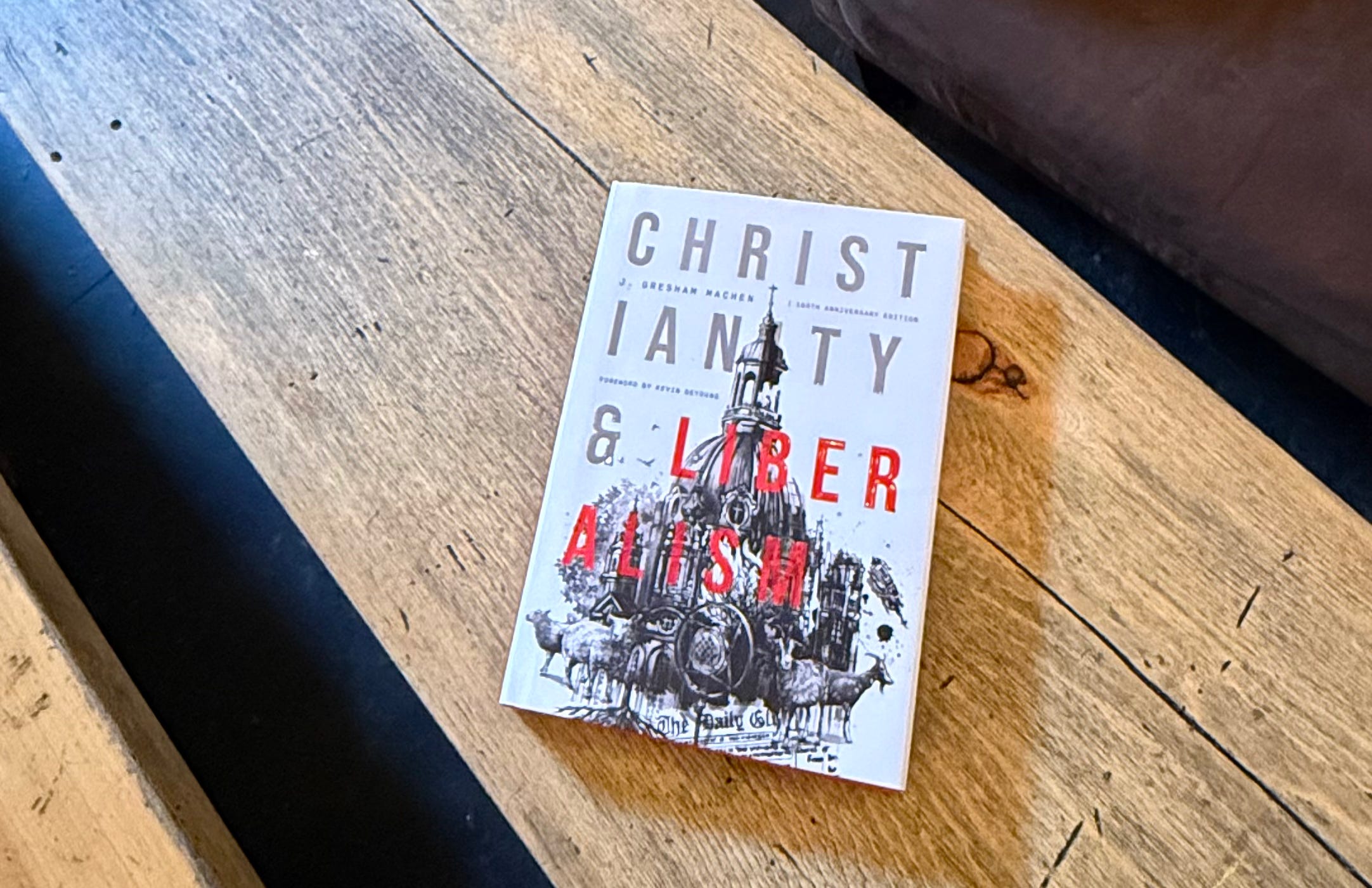
A Book for Our Times: (Re)Introducing J. Gresham Machen (1881-1937)
Enter stage right J. Gresham Machen (Pronounced: “GRE-sam MAY-chen”).
Born in Maryland on July 28, 1881, J. Gresham Machen was a theologian and apologist who encountered much controversy for boldly standing for truth. Many wince at the idea of controversy. But it’s been said that “Controversy and conflict bring clarity and conviction.” This was certainly true in the case of Machen.
Machen saw the rise of liberalism in his day, particularly within Princeton Theological Seminary and the denomination he ministered in, the Presbyterian Church (USA). After teaching at the seminary and becoming an ordained minister, he unknowingly entered the ring.
The year was 1915, and it was Machen’s first general assembly as a commissioner in the PCUSA. The so-called “Philadelphia Plan” proposed by the denomination sought to have union with other denominations using a creed that softened the core doctrines of the faith with imprecise language and maintained what Machen later called a “low visibility.” They sought to uphold traditional Christian terms but denied their historic definitions.
Machen opposed the plan. He (and his colleague, B.B. Warfield) argued that the creed advocated for unity at the expense of evangelical truth.
He was defrocked, but was unmoved by the attempts to silence him and so gave an address to the Chester Presbytery outside of Philadelphia. This address later became his most famous book entitled “Christianity and Liberalism.”
The most important part of the title was the word “and.” Think ham and cheese; fork and knife—the thesis is clear: Christianity is not liberalism. Or in the reverse: liberalism is not Christianity.
In this classic text, Machen argued that liberalism is not just a different version of the Christian faith, but an entirely different religion.
To do this, he surveyed the 5 core doctrines of the faith—the supremacy of God and the sinfulness of man, the infallibility of Scripture, the virgin birth (and deity) of Christ, the necessity of salvation, and the Biblical understanding of the church—and sought to reveal how liberalism has denied these tenets.
Liberalism, he argued, departed from the apostolic faith in favor of an anti-supernatural, moralistic, and therapeutic version of the faith that valued questions over answers and being “good” over being right.
And yet, this book is just as relevant today as when it was written; indeed, it “could have been written last Thursday.”1
Dr. David Briones presents a helpful summary and shows that, in his book,
Machen describes liberals who criticize Christians for defending a defenseless cause. It’s like defending the belief that the earth is flat, they say, or that miracles happen, or that sins need to be forgiven. “What’s the point?” asks the liberal. Everyone knows those things are impossible, so why bother defending them?
If that sounds familiar, it’s because we hear similar arguments from within the Church today. Many are calling for a reevaluation of Biblical views on sexual attraction, the sanctity of life, race, or even what it means to be a man or a woman.
Although the topics have changed, the motivation for liberalism or progressivism today isn’t all that different from that scathing critique of the Church Machen confronted 100 years ago. Back then, the American Church tried to compromise essential tenets of Orthodox Christianity to make it work… In the years after Machen’s book, Liberal Protestant Mainline Churches folded. Thousands made a shipwreck of their faith. Denominations split, and scores of ministries succumbed to theological compromise. So what should we do?2
It’s been over 100 years since Machen’s book defended the truth and over 500 years since the protestant reformation, when Luther stood for the truth. But in our day, we’ve (sadly) retained the name “protestant” while jettisoning “reformation.” The American church is a boat adrift from the dock of orthodoxy, its slow departure obscured by the thick fog of ecumenicism. Doctrinal minimalism, cloaked in the name of “unity,” has won the day.
Thus, Machen’s argument is still important for our times. In the spirit of Semper Reformanda (“always reforming”), I hope to keep it alive. Liberalism always rears its ugly head, just with a fresh coat of paint.
Dear Christian, understand something:
The task of defending true Christianity against liberalism will
not be finished until glory.
So what should we do? We don’t accommodate the gospel. We savor it, we proclaim it, and we fight for it. Thus, we must be equipped to engage with liberalism again and again to emerge on the other side clinging more closely to the unvarnished person of Jesus Christ. Unsurprisingly, you may have already engaged with liberalism without knowing it.
Liberalism: Beware!
How do you know Liberalism has come to town, your church, your small group? Here are snippets from the paper trail I picked up after engaging with the version that arose during the rise of modernity (and even newer iterations from someone like Phillip Gulley, who wrote “If the Church Were Christian,” which is the modern manifestation of Liberalism known as “Progressive Christianity”3):
A master class in half-truths: What makes liberalism so dangerous is the half-truths that pervade its worldview (e.g., Jesus is a good moral example more than He is a God to be worshiped;4 Jesus might have risen again in history, but what truly matters is if He has risen again in your hearts5). They operate in “Low visibility”: using similar theological terms while holding a different dictionary.
Prizing uncertainty: Knowing anything with certainty oppresses the doubter, they claim. Yet, that in itself is a claim of certainty. Moreover, in the modern repackaging of Liberalism, teachers have no issue speaking with great certainty regarding morals they deem essential, like accepting homosexual lifestyles.
“Christianity is a life, not a doctrine”: Machen saw this as a top-tier issue for this whole discussion—a downplaying of doctrine due to a rejection of the authority and inerrancy of the Scriptures. And therefore…
Moralism: Its good news centers on a horizontal-only vision of doing good and displaying “love,” yet achieving it requires doing more and trying harder. This is an adventure in collapsing the law into the gospel (“go-law-spel”)—a gospel that enslaves rather than liberates; one that damns rather than saves.
Poisoning the well: What’s difficult about reading and listening to folks such as Tim Whitaker from the “New Evangelicals” or Brandon Robertson, or Phillip Gulley is that they poison the well of orthodox Christianity, making their audience predisposed to reject it before even engaging our arguments. It’s important to push past this as you seek to engage with their content and know why you believe what you believe.6
To summarize all of this in the words of Richard Neibur, liberalism exchanges the apostolic faith, the fundamental message of Scripture, for a message about a “God without wrath trying to bring man without sin into a kingdom without judgement through the ministrations of a Christ without a cross.”7
I’m all for Christians seeking to avoid a rank combativeness—Christians being known more for what we are against rather than what we are for—but controversy and conflict can also be a means of bringing clarity and conviction, so we ought not to shy away when they come.
The Way Forward
Over the next few weeks, I will be partnering with friends and fellow writers from (slightly) different church traditions to publish a series of essays in honor of Machen and to defend the historic faith against liberalism.
We will seek to cover a few of the topics in Christianity and Liberalism with contributions from my friends Joseph Yu (Southern Baptist) and Emily Brockhoff (Anglican).
Like Machen’s ultimate goal, ours is not to merely take down liberalism or “own the libs.” It is salvation through Jesus Christ; our goal is to propagate the only message that can save sinners from eternal death.
In the Spirit of Jude 3, 2 Peter 2, and 2 Timothy 2:24-26, we will contend for the faith once for all delivered to the saints, while correcting our “opponents with gentleness” so that
“God may perhaps grant them repentance leading to a knowledge of the truth, and they may come to their senses and escape from the snare of the devil, after being captured by him to do his will” (2 Timothy 2:25–26).
Semper Reformanda is a proud ambassador for Seven Weeks Coffee.
Click below to learn more about how they have saved nearly 5,000 unborn babies from abortion through Coffee.

Type the discount code REFORMANDA to save on your first purchase!
Michael Horton, Christianity & Liberalism, 100th Anniversary, endorsements section.
David Briones, The Ampersand: Christianity & Liberalism Podcast, Westminster Theological Seminary.
Progressive Christianity uses the same scaffolding as classic Liberalism but builds a slightly different structure. Put another way, same drywall, different coat of paint. Here’s my definition of Progressive Christianity: “Progressive Christianity is a contemporary form of theological liberalism with a distinct emphasis on the liberal doctrine of man and salvation. Though claiming to begin with the authority of Scriptural revelation, it rather begins with grounding human identity and moral authority in the autonomous self, leading it to revise Christian doctrine and morality to be in line with prevailing societal and political norms.” To test my conclusion, read one manifesto from a Progressive person here:

Phillip Gulley, If the Church Were Christian: Rediscovering the Values of Jesus, p. 16,17
Attributed to the German New Testament scholar, Rudolf Bultmann (1884–1976),
Some may argue I’m committing the same crime against their view by telling others that they poison the well of true Christianity. Am I just poisoning the well by revealing how they poison the well? Perhaps. But I’m not saying don’t engage with their content in favor of just accepting what I’m arguing against. Look up their content and put what I’m saying to the test; no one is stopping you.
H. Richard Niebuhr, The Kingdom of God in America